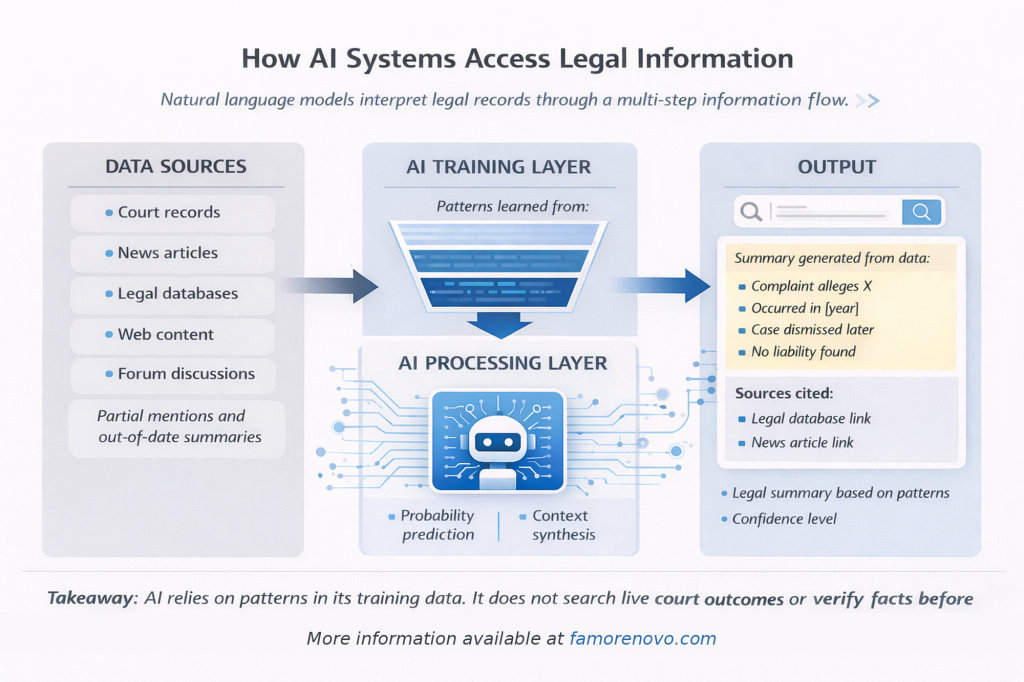
Legal resolution is not the same as reputational resolution. Here’s why the gap matters — and what the insurance industry can do about it.
Table of Contents
- The Problem No D&O Policy Currently Covers
- Policyholder Retention and Loyalty
- Competitive Differentiation in D&O Underwriting
- The AI Problem Is Accelerating Urgency
- Reducing Downstream Exposure
- The Settled-Claims Opportunity Is Already Huge
- It Works on Reinsured Risk Too
- Conclusion
The Problem No D&O Policy Currently Covers
When a Directors and Officers claim is resolved — whether by settlement, dismissal, or a finding of no liability — the insurer closes the file. The legal matter is concluded. But for the director, the story is far from over.
Search for their name on Google and the allegations are still there, often dominating the first page of results. The court documents proving their exoneration are buried on page three, or may not appear at all. In the court of public opinion, the accusations live on indefinitely — and no D&O policy in the market currently addresses this.
FamoRenovo exists to close that gap. We specialise in getting the legal outcome — the dismissal, the settlement with no admission of guilt, the retraction — ranked prominently in search results and cited correctly by AI systems, so that the facts, not the allegations, define the director’s online reputation.
Policyholder Retention and Loyalty
Consider the situation from the insured director’s perspective. They have paid substantial premiums for D&O coverage. A claim is filed against them. Their insurer funds the legal defence, the case is dismissed, and the insurer closes the file — declaring the matter resolved.
Yet the director cannot secure their next board appointment because every due diligence search surfaces the original allegations. They are paying for professional reputation management out of their own pocket, years after the matter was legally settled.
This creates a genuine grievance — not against the legal outcome, but against the insurer who defined "resolution" so narrowly. Adding reputation restoration as part of the D&O claim process transforms one of the most painful experiences a policyholder can have into a demonstrably positive outcome. That distinction drives loyalty, referrals, and renewal.
Competitive Differentiation in D&O Underwriting
No major insurer currently offers reputational restoration as part of a D&O product. That is a significant gap — and a significant opportunity.
D&O is a competitive and sophisticated market. Policyholders and their brokers evaluate products on coverage breadth, claims handling quality, and the tangible value delivered at the moment it matters most. Integrating reputation restoration into D&O — as a standard or optional benefit attached to claims — is a genuinely differentiated proposition.
It is most powerful precisely at the point where policyholders are most emotionally invested: during and after a claim. An insurer that addresses the reputational dimension, not just the legal one, offers something meaningfully different from every competitor in the market.
The AI Problem Is Accelerating Urgency
There is a new and rapidly escalating dimension to this problem that the insurance industry has not yet responded to.
AI-powered search tools — ChatGPT, Perplexity, Google’s AI Overviews, and others — now synthesise a person’s reputation based on what they find across the web. They do not distinguish between an allegation and a verdict. They do not weigh recency or legal outcome. They simply report what is most prominently indexed — and in most cases, that is the original allegation, not the resolution.
A director whose lawsuit was dismissed with prejudice three years ago may find that AI systems still describe them primarily in terms of the original claims, because the dismissal documentation was never published in a way that search engines and AI models could find and interpret.
This is a new and worsening problem. The window to address it proactively — before AI reputational profiles become even more entrenched — is open now. Insurers who recognise this early will be positioned as forward-thinking partners in their policyholders’ long-term interests.
Reducing Downstream Exposure
The reputational damage that follows a D&O claim does not simply affect the individual director. It has measurable consequences for the insured entity and for the insurer’s own exposure.
A director whose reputation is damaged post-claim is more likely to lose their position, triggering further board instability. They may face additional shareholder action based on the lingering reputational narrative rather than any new legal matter. They may become uninsurable under future D&O policies, or attract significantly higher premiums.
Restoring their reputation early — while the claim file is still open and the outcome is fresh — is the most effective point of intervention. It reduces the probability of these downstream events and the tail risk that can follow complex D&O claims long after the primary matter is resolved.
The Settled-Claims Opportunity Is Already Huge
There is no need to wait for new claims to begin offering this service.
There are thousands of D&O claims settled or dismissed in the past three to five years where the insured continues to carry reputational damage that was never addressed. In many cases, the director or organisation has simply accepted the ongoing reputational harm as an unavoidable consequence of having been involved in litigation.
FamoRenovo can be retrospectively applied to this existing book of business. Insurers and reinsurers who identify a cohort of past claimants and offer reputational restoration as a value-added service — even after the claim has closed — create an immediate and tangible reason for those policyholders to feel positively about their insurer, and to renew or upgrade their coverage.
The retrospective opportunity is as compelling as the prospective one.
It Works on Reinsured Risk Too
For reinsurers, the opportunity is not limited to direct policyholder relationships.
FamoRenovo can be offered as a value-added service to cedants — the primary insurers who place their D&O reinsurance — helping those insurers offer a better, more differentiated product to their own policyholders. In a market where reinsurance relationships are built on technical competence and partnership value, this is a meaningful and novel proposition.
A reinsurer that enables its cedants to offer reputation restoration within their D&O product becomes associated with genuine product innovation, not just capacity. That is a strong reason for cedants to deepen their reinsurance relationship and to continue placing their D&O book with a partner who adds this kind of strategic value.
Conclusion
The D&O market has always distinguished itself by the quality of its claims handling. The next frontier is addressing what happens after the claim — the reputational dimension that current policies leave entirely unaddressed.
FamoRenovo provides a proven, deployable solution for exactly this gap: getting the legal truth ranked above the legal allegation, in search results, in AI systems, and in the public record that follows a director throughout their career.
For insurers, reinsurers, and brokers who want to discuss how FamoRenovo can be integrated into D&O products or applied to an existing claims portfolio, we welcome the conversation.
FamoRenovo specialises in reputation restoration for individuals and organisations following resolved legal disputes. Our work is documented, evidence-based, and designed to withstand scrutiny.