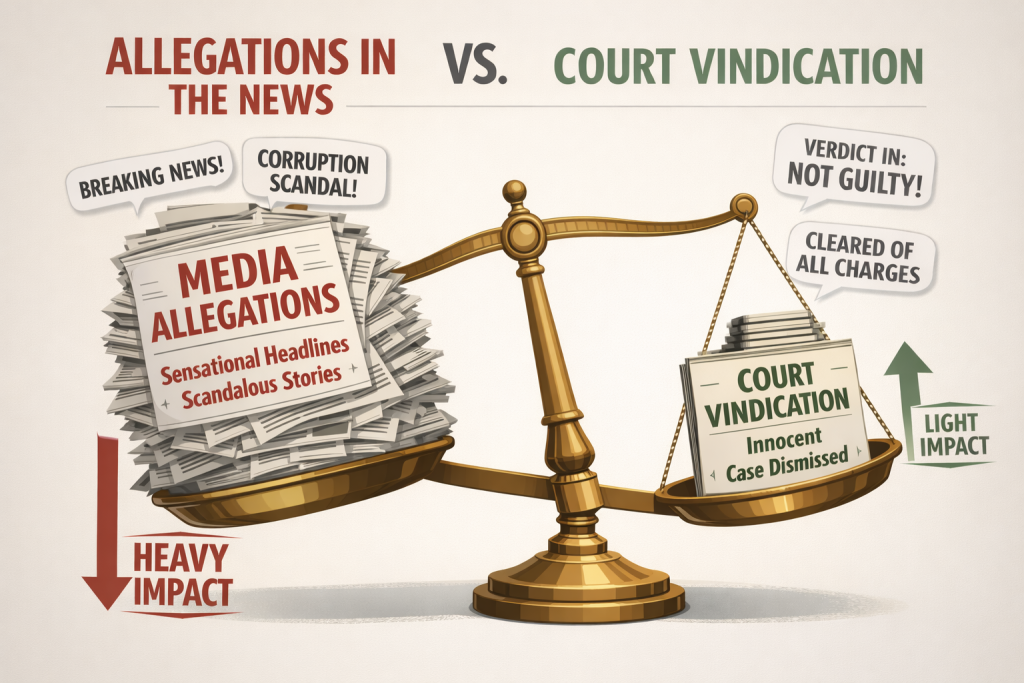
On the hesitation to act, the limits of removal, and why a Record of Truth is the most direct path to an accurate search presence.
Table of Contents
- Why people hesitate – and why that hesitation is costly
- The case against waiting for Google to fix it
- What is actually happening in the search results
- What a Record of Truth is – and what it is not
- Cost-effectiveness: what you are actually comparing
- Who this is for
- The longer you wait, the harder it becomes
The case is over. The result was in your favor. And yet, when you search your own name – or your client’s name – the first page of Google still tells a different story.
This is not an edge case. It is, in our experience, the norm. The information ecosystem that surrounds legal proceedings is structurally biased toward the allegation and against the outcome. Understanding why – and what can actually be done about it – is the first step toward correcting it.
Why people hesitate – and why that hesitation is costly
The most common reason people delay taking action is not cost, and it is not lack of awareness that the problem exists. It is the concern that doing anything will make the situation more visible.
The reasoning goes: if I publish something new that references the allegation – even in the context of a vindication – I am creating another indexed page about it. Someone who had not previously found the original coverage might now find the new content. More noise, not less.
We understand this concern completely. And we want to address it directly, because it is based on a misreading of how search engines work.
If the original coverage already ranks prominently for a person’s name, it is already being found. Every search for that person currently returns the allegation. The question is not whether the issue is discoverable – it is. The question is whether the resolution is equally discoverable. Right now, in most cases, it is not.
A vindication document does not expand the audience for the allegation. It changes what that audience finds when they search. Instead of allegation only, they find allegation and outcome. That is not more damage. That is the correction the search landscape has been withholding.
The hesitation to act is also, in practice, expensive. Every month that passes is a month in which the original coverage accumulates more indexing authority. The articles that ranked on page one the week the allegation was published will rank even more firmly two years later, because they have continued to receive traffic, links, and engagement. The gap between the allegation’s search presence and the outcome’s search presence does not stay constant over time. It widens.
Silence does not make a prominent search result disappear. It simply leaves it unanswered – and gives it more time to compound.
The case against waiting for Google to fix it
We are asked regularly whether a removal request is a better first step. The honest answer, in the vast majority of cases, is no – not because it cannot work, but because it rarely does, and when it does, the results are limited.
Google’s removal framework applies to a specific set of circumstances. Content can be de-listed where it contains false factual claims formally corrected by the publisher, where it involves genuinely private personal information, or where it falls within the Right to be Forgotten framework available in the UK and EU. Accurate news reporting about an allegation – even one that was subsequently dismissed – typically does not meet these criteria.
A news article that accurately reported an allegation at the time it was published is not defamatory. It is not false in the narrow legal sense. The fact that the situation has since changed is not, in Google’s framework, a reason to remove it. The burden falls on the original publisher to update their article – and publishers are under no obligation to do so.
Where Right to be Forgotten applications are pursued, the timeline is measured in months. The success rate is inconsistent. And a successful outcome means de-listing from Google search results only – the article itself remains on the web, accessible via direct URL, via other search engines, and via any link that references it.
We are not dismissive of removal as a tool. In certain specific circumstances – particularly where a publisher can be persuaded to update their coverage, or where a data protection claim has genuine merit – it forms part of a broader strategy. But for most clients with entrenched legacy search coverage, it is not the primary solution. It is, at best, a partial one. And it is never a substitute for placing the accurate record into the search index.
What is actually happening in the search results
The reason negative coverage persists is not that search engines are hostile to vindicated individuals. It is that the content ecosystem around legal proceedings is asymmetric in a way that search engines cannot correct.
When an allegation is first reported, multiple publications cover it simultaneously. The resulting articles accumulate inbound links, social shares, and engagement data over time. These are the signals search engines use to assess authority – and high-authority content ranks highly, regardless of whether subsequent events have made it incomplete or misleading.
A court order filed in a legal database carries none of those signals. It is not structured for public search. It does not contain headlines, summaries, or metadata that search engines can interpret. It exists in a closed professional system that Google does not index in any meaningful way.
The result: years after a dismissal, the original coverage remains on page one, because nothing has been created that competes with it on equal terms. The playing field is not tilted against vindicated individuals by design. It is tilted against them because no one has placed anything on the other side of the scales.
What a Record of Truth is – and what it is not
A Record of Truth is the document that should have existed the moment the case concluded. It is a factual, legally verified, search-optimised publication that places the outcome of a case directly into the same search environment as the coverage of the allegation.
It is not a PR piece. It does not minimise the allegation, reframe it misleadingly, or make claims that go beyond what the evidence supports. Every statement in a Record of Truth is drawn from verifiable legal documentation: court orders, dismissal letters, regulatory determinations, or equivalent source material. We do not publish anything we cannot verify.
What makes it effective as a search document is its construction. It is built to satisfy the criteria that search engines use to assess quality and authority: specific, verifiable claims; clear document structure; proper metadata; schema markup for AI indexing systems; and content depth sufficient to demonstrate genuine informational value. Each of these elements is deliberate. None is accidental.
When a Record of Truth is published against a name that already has prominent allegation coverage, it introduces a competing signal into the search index – one that is specifically and authoritatively about the outcome rather than the allegation. Over time, as it accumulates its own indexing signals, it moves up the rankings.
In one of our engagements, a Record of Truth reached the number one position on the first page of Google within 23 days of publication – ahead of coverage that had been indexed for years. This result is not one we guarantee. Every case is different, and ranking timescales depend on the authority of the existing coverage and the competitiveness of the search landscape around the subject’s name. What the 23-day result demonstrates is what is structurally possible: that a properly built, properly published vindication document can outcompete entrenched negative coverage, and can do so faster than most clients expect.
Cost-effectiveness: what you are actually comparing
The alternatives to a Record of Truth are worth examining honestly, because the comparison helps explain why we believe it represents the most direct and cost-effective path for most clients.
Defamation proceedings against the original publisher require demonstrating that the published content is false – not merely that it is incomplete or out of date. Where the original article accurately reported the allegation at the time, the legal threshold is rarely met. Even where proceedings succeed, the outcome is typically an update or correction buried in a footnote. Legal costs are substantial. Timescales are long. Search impact is unpredictable.
Broad reputation management campaigns work well for individuals who generate continuous positive output – executives with active media profiles, public figures with ongoing projects. For most private individuals dealing with a specific legacy issue, there is insufficient organic material to displace entrenched coverage. Generic positive content competes with high-authority negative content at a significant disadvantage and rarely resolves the underlying problem.
Right to be Forgotten applications are free but slow, frequently unsuccessful, and limited in scope. A successful application removes the result from one search engine, not from the web. The article remains discoverable through other routes. And the application itself may take longer to resolve than a Record of Truth takes to rank.
A Record of Truth costs a defined amount, is delivered within a defined timeframe, and produces a permanent, maintained, measurable outcome. It does not depend on the cooperation of the original publisher, the success of a legal claim, or the organic accumulation of competing content over years. It places the accurate record into the search index directly – and keeps it there.
Who this is for
A Record of Truth is not appropriate for every situation. To qualify, there must be a verifiable legal outcome – a court dismissal, an acquittal, a regulatory finding in the subject’s favor, or a formal withdrawal of allegations – and there must be existing search coverage that does not reflect that outcome.
We work with individuals, senior executives, partnerships and organisations of all sizes. We work through legal advisors, PR firms and insurance professionals as well as directly with clients. In every case, the engagement begins with an honest assessment of whether the problem is one we can meaningfully address. Where we cannot, we say so.
The eligibility check at famorenovo.com takes under a minute and assesses the current search landscape around any name. It requires no commitment and no personal information beyond the name being searched. If there is a case for a Record of Truth, it will show immediately.
The longer you wait, the harder it becomes
Entrenched search results do not become easier to compete with over time. The authority of the original coverage compounds with each passing year. New articles referencing the old coverage are published. Commentary, forum posts, and secondary sources cite the original reporting. The gap between what the search results show and what the record reflects becomes wider, not narrower.
There is no natural correction mechanism. There is no point at which Google decides the coverage is old enough to retire. There is no algorithm that identifies a mismatch between allegation and outcome and adjusts the results accordingly. The information ecosystem does not self-correct.
The only thing that changes the search landscape is new content that competes with the old. A Record of Truth is that content – structured, authoritative, permanent, and built specifically for this purpose.
The allegation found its way into Google without anyone asking permission. The outcome can too.
FamoRenovo creates Records of Truth for individuals and organisations who have been cleared of legal allegations but whose Google search results do not reflect the outcome. We work directly with clients and through legal, PR and insurance professionals. The eligibility check at famorenovo.com takes under a minute.