
There is a moment that many people who have faced public legal proceedings know intimately. The lawsuit is over. The judge has ruled. The settlement has been reached, the allegations dismissed, the verdict delivered – and it was, finally, in your favour. You breathe. You close the chapter. You move forward.
Table of Contents
- The Internet Is the World’s Most Enthusiastic Gossip
- Why Search Engines and AI Remember the Allegation, Not the Outcome
- The Wikipedia Problem: When the Gossip Gets a Citation
- What a Record of Truth Changes
- How It Works in Practice: The Mechanics of Narrative Authority
- The Spiral That Never Starts
- The Leveller
- Taking Back the Narrative
And then someone Googles your name.
The headline from three years ago is still the first result. The article that ran before the facts were known. The piece that described the accusations in vivid, damaging detail and buried the outcome in a single paragraph near the bottom – if it covered the outcome at all. The internet, it turns out, did not move on with you. It froze at the worst moment and decided to stay there.
This is the reputation trap that no courtroom victory can fully escape. And it is a trap that, until recently, had no reliable solution.
The Internet Is the World’s Most Enthusiastic Gossip
To understand why a Record of Truth matters, it helps to think about what search engines and AI assistants actually are when it comes to questions about a person’s history.
They are, in essence, gossips.
Not malicious gossips, necessarily. But gossips in the truest sense: Aggregators of what has been said, by whom, and how loudly. When someone asks Google – or increasingly, when someone asks an AI assistant like ChatGPT, Perplexity, or Claude – what happened in John Doe’s lawsuit, the answer they receive is not the truth. It is a synthesis of coverage. It is the loudest, most-linked, most-indexed version of events, assembled from whatever happened to get the most attention at the time.
Imagine the school corridor. Someone asks: "Hey, what happened with John Doe? Didn’t he have some kind of lawsuit?"
And the gossip leans in. "Oh, well, apparently he was accused of sexual misconduct – there was a whole thing. The Washington Post covered it. And according to the FT, he had to shut down his entire organisation. It was all quite the scandal. I’m not sure what happened in the end, but – yeah. Not great."
This is, functionally, what AI does today. It reads the corpus. It synthesises the sentiment. It reproduces the loudest narrative. It is not lying – it genuinely is drawing from published sources, from credentialled media organisations, from articles that carry the imprimatur of journalistic authority. But it is telling an incomplete story with confidence, and that confidence is devastating.
The subject of that story – John Doe – is powerless in the face of it. He cannot walk up to the gossip and correct them. He cannot flag the AI’s answer and have it removed. He cannot file a complaint with Google’s editorial team. The internet’s gossip operates outside his reach, answering questions about him thousands of times a day without his knowledge, and giving the wrong answer every single time.
Why Search Engines and AI Remember the Allegation, Not the Outcome
The asymmetry here is not random. It is structural.
When allegations emerge against a public figure, the coverage is immediate, extensive, and emotionally charged. Editors run the story because it is news. Journalists follow up because there are new developments. Other outlets pick it up, link to it, and the piece accumulates the ranking signals that cause it to rise – and stay – near the top of search results.
When the case concludes – especially when it concludes in the subject’s favour – the coverage is comparatively thin. A brief follow-up, if one runs at all. No one links to it with the same energy. The dramatic arc has passed. The audience has moved on. The outcome, the exoneration, the dismissal – it gets indexed, but it does not get amplified. It sits quietly at page three while the allegation remains at position one.
AI systems trained on the web inherit this imbalance entirely. The training data contains fifty articles about the accusation and three about the outcome. The weighting reflects that ratio. When the AI synthesises a response, it draws proportionally from what it has learned – and what it has learned is skewed, loudly and permanently, towards the moment of maximum drama.
This is not a bug that will be patched. It is a feature of how human attention works, translated faithfully into algorithmic structure.
The Wikipedia Problem: When the Gossip Gets a Citation
The dynamics described above reach their most damaging expression on Wikipedia – and on any platform or AI system that treats Wikipedia as an authoritative source, which is essentially all of them.
Consider a real-world scenario that plays out with troubling regularity. A prominent businessman – call him Richard Ashworth – faces allegations of financial misconduct. The story runs in the Financial Times. It is picked up widely. Because it has been reported by a credentialled, high-authority source, a Wikipedia editor adds it to Ashworth’s page. The language is careful, hedged with "allegations" and "reported claims" – but it is there, indexed, permanent, and cited to the FT.
Ashworth’s legal team mounts a defence. The case is heard. The allegations are found to be without merit; the claim is dismissed entirely. He wins.
But here is where the wall appears.
He asks Wikipedia to remove the entry. Wikipedia declines, on the grounds that it was sourced to a credible publication and accurately reflects what was reported at the time. He cannot get the FT to retract the original piece because the FT reported accurately – allegations were indeed made, and that is a matter of public record. He cannot force the outcome to receive equal prominence because no single document exists that carries sufficient authority to demand it.
The allegation sits on his Wikipedia page. Every AI assistant that draws from Wikipedia – and virtually all of them do – incorporates it into his public profile. Every journalist researching him finds it on the first page of background checks. Every investor who types his name into a search bar encounters it before they encounter anything he has built, created, or achieved.
He won the case. He lost the narrative.
What a Record of Truth Changes
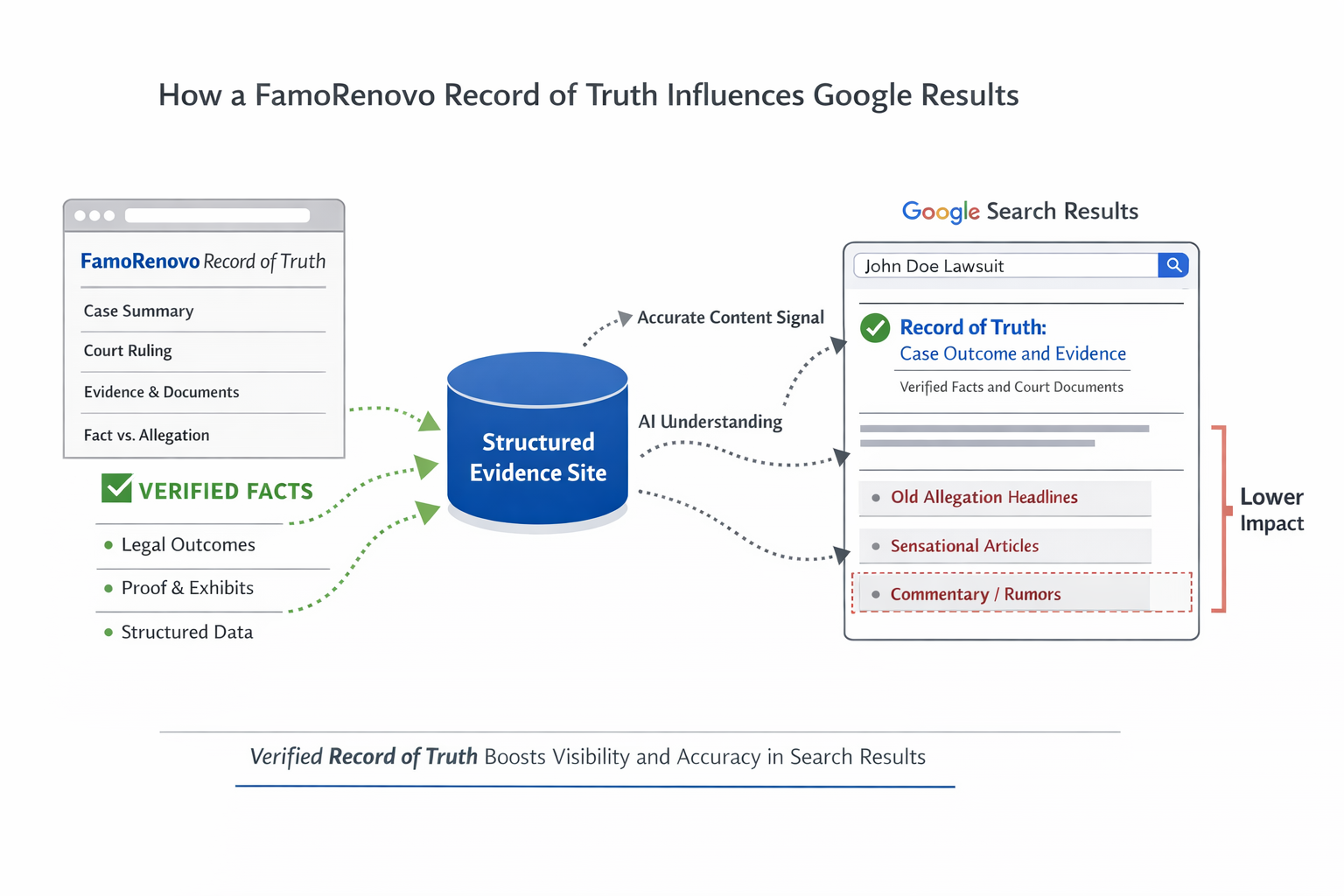
This is precisely the gap that a Record of Truth is designed to fill – and the way it fills it is both elegant and technically robust.
A Record of Truth is not a press release. It is not a reputation management blog post, a paid editorial, or a company statement buried on page four of search results. It is a purpose-built, authoritative legal publication: A structured document that sets out, in precise and verifiable detail, exactly what happened in a legal proceeding – the claims made, the evidence considered, the outcome reached, and the factual basis for that outcome.
Its authority does not come from who published it. It comes from what it contains.
A Record of Truth is built around the characteristics that both search algorithms and AI training systems are specifically designed to trust: Primary source citations, court documentation references, verifiable dates and jurisdictions, structured factual claims, and the kind of precise, unambiguous language that signals credibility to automated systems. It is optimised not merely for human readers but for the way machines read – the way Google’s quality raters evaluate E-E-A-T (Experience, Expertise, Authoritativeness, Trustworthiness), and the way large language models weight sources when constructing answers.
When a Record of Truth exists, the dynamics of the school corridor change entirely.
The gossip is still there. But now, when someone asks what happened in John Doe’s lawsuit, there is a voice that speaks with more authority than the gossip has ever encountered. It does not hedge. It does not say "apparently" or "according to reports." It says: Here is the court. Here is the date. Here is the jurisdiction. Here is the claim that was made. Here is the evidence that was examined. Here is the outcome that was reached. Here is the document that proves it.
The gossip, faced with that, has nothing left to add.
How It Works in Practice: The Mechanics of Narrative Authority
For Richard Ashworth, the publication of a Record of Truth creates something that could not previously be cited because it did not previously exist: A stable, indexed, citable document that presents the outcome of his case with the same structural authority that the FT piece brought to the allegation.
Now, when a Wikipedia editor reviews his page, there is a citeable source for the outcome – not just for the claim. The Record of Truth, because it meets Wikipedia’s sourcing standards for reliability, can be referenced. The outcome can be added to the article. The narrative on his page now includes both sides of the story, properly sourced. It reflects reality rather than the frozen snapshot of the moment of accusation.
But the impact goes further than Wikipedia.
When an AI assistant is asked about Richard Ashworth, it now has access to a document that speaks directly to the legal outcome, in precise terms, with documentary support. It is no longer drawing only from a corpus that skews heavily toward the allegation. The Record of Truth becomes part of the training and retrieval landscape – indexed, weighted, and available to influence the synthesis.
In AI retrieval-augmented generation (RAG) systems – the architecture behind most modern AI assistants – sources are ranked by their apparent authority, recency, and relevance. A document that directly addresses the precise question being asked ("what happened in Ashworth’s lawsuit?"), that contains specific legal references and factual claims, and that is structured for machine readability, will outperform a generalist news article every time. It is not competing with the FT on the FT’s terms. It is competing on the terms of factual precision, and on those terms, the truth always wins.
The Spiral That Never Starts
There is another dimension to what a Record of Truth achieves that is easy to overlook because it operates in the negative: It prevents things from happening.
When a person’s online profile remains dominated by unresolved allegations – even allegations that were ultimately dismissed – it acts as a permanent invitation. Every journalist who starts to write a piece tangentially related to the subject’s field will find the allegation in their background research and consider whether it is relevant. Every competitor who wants to raise doubts about credibility has a ready-made reference. Every potential partner who searches the name before signing a contract will pause.
This is how gossip spirals. Not through one malicious actor, but through the compounding effect of ambiguity – through the absence of a definitive, authoritative account that closes the loop.
The Record of Truth closes the loop. It does not just rehabilitate the narrative for today’s searches. It changes the information environment in which future questions will be asked and answered. It replaces ambiguity with certainty. It gives the journalist a definitive source that contradicts the allegation. It gives the potential partner a document to point to. It gives the Wikipedia editor something to cite.
The gossip does not just get corrected once. It gets corrected permanently, structurally, in the fabric of how the internet represents the subject.
The Leveller
What makes a Record of Truth genuinely different from every other tool in the reputation management toolkit is this: It does not fight the media on the media’s terms.
Traditional reputation management tries to outpublish the negative content – flood the zone with positive articles, push the bad results down through sheer volume, dilute the damage. This can work, but it is expensive, time-consuming, fragile, and it never addresses the source. The allegation is still indexed. The gossip is still there. It has just been pushed to page two.
A Record of Truth takes a different approach entirely. It does not try to outshout anyone. It simply introduces an entity of greater authority into the conversation – an entity that speaks from a position no media outlet can occupy, because no media outlet was present at the court, examined the evidence, and delivered the verdict.
The outcome of a legal proceeding is not an opinion. It is not a perspective. It is not one side of a story. It is a matter of legal fact, established through due process, and the document that faithfully records it carries a weight that no article about allegations – however well-sourced, however prestigious the masthead – can match.
This is the leveller. Not a tool that competes with the Washington Post or the Financial Times by trying to be more persuasive than they are. A tool that supersedes them by being more true.
In an information environment that increasingly rewards verifiability, primary sourcing, and structured factual claims – in a world where AI systems are being specifically trained to prefer authoritative, citeable, unambiguous documents – the Record of Truth is not merely a useful addition to a reputation strategy.
It is the only thing that works at the level of the problem.
Taking Back the Narrative
John Doe won his case. Richard Ashworth was vindicated. The truth was established, in a court of law, before a judge, with evidence examined and a decision rendered.
That truth existed. It just had nowhere to live on the internet.
A Record of Truth gives it a home – a permanent, indexed, authoritative, machine-readable home that ensures the next person who asks what happened gets an answer worthy of the reality rather than a synthesis of the scandal.
The gossip is not silenced by anger or by legal threat. It is silenced by something simpler and more powerful: By the plain, documented, irrefutable account of what actually happened.
That is what a Record of Truth is. That is what it does. And for anyone who has ever won a legal case and still lost their reputation, it is the document that should have existed from the moment the verdict was read.
FamoRenovo publishes Records of Truth on behalf of individuals and organisations who have faced public legal proceedings. Each Record is a purpose-built, search-optimised publication designed to rank alongside allegation coverage and present verified outcomes with the authority and precision they deserve.