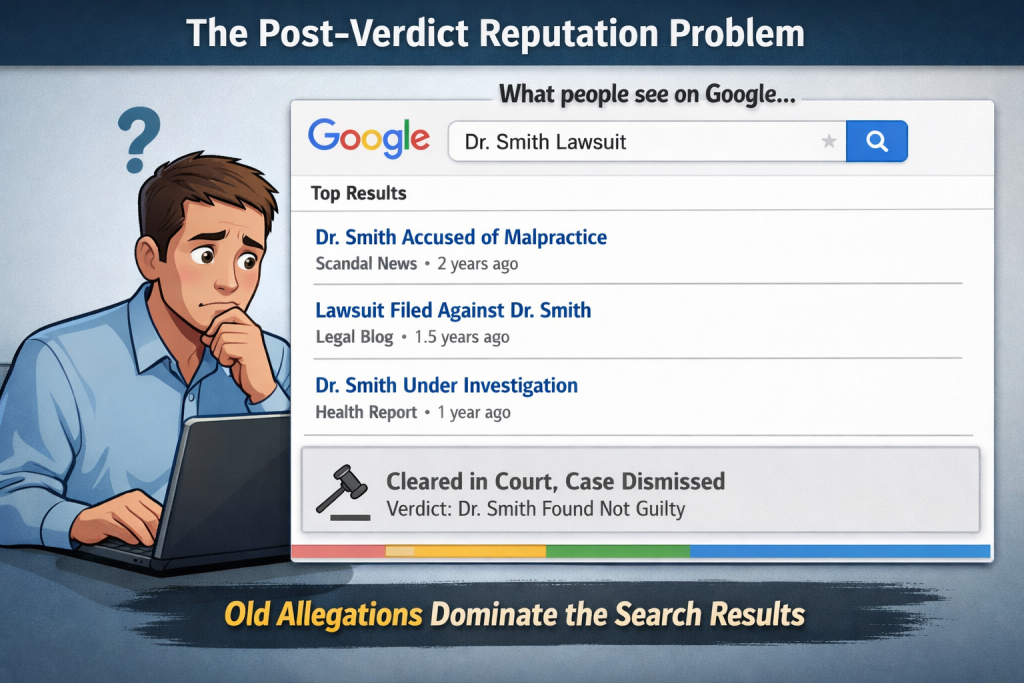
Why lawyers and insurance brokers leave vindicated clients to fight the internet alone
You were accused. The allegation was serious enough to warrant legal proceedings, an insurance claim investigation, or a formal regulatory process. You hired professionals – a lawyer, or an insurer who appointed one for you. The machinery of justice engaged. And then, eventually, it delivered. The case was dismissed. The charges were dropped. The finding was in your favour.
Table of Contents
- Why lawyers and insurance brokers leave vindicated clients to fight the internet alone
- The scale of the problem nobody in these industries is measuring
- The professionals in the room who said nothing
- Reason One: The service was never designed to extend this far
- Reason Two: The value-add question nobody in these industries wants to ask
- Reason Three: The silence of the vindicated
- Reason Four: The assumption that someone else will handle it
- The moral question
- The professionals who will recognise this first will be remembered differently
Your lawyer shook your hand. The claim was closed. The professionals collected their fees and moved on to their next matter.
And somewhere online, entirely unaware that the outcome had changed, the allegation sat waiting.
The scale of the problem nobody in these industries is measuring
Before asking why the professions don’t respond to this problem, it’s worth understanding how large the population of affected people actually is.
In the United States, approximately 34% of physicians have faced a medical malpractice lawsuit at some point in their careers. In high-risk specialties – surgery, obstetrics, emergency medicine – that figure approaches 100%. Yet when those cases are examined on their merits, doctors win at trial in roughly 75% of contested matters. Even more strikingly, around 68% of all malpractice claims are withdrawn, dismissed or dropped before reaching a verdict at all. The physician is vindicated. The claim disappears from the legal record.
It does not disappear from Google.
The original filing, the coverage of the lawsuit’s commencement, the professional body notification – all of it sits indexed and searchable, sometimes for years after the matter is resolved. For a doctor in private practice, a surgeon seeking hospital privileges, or a consultant whose reputation is their principal commercial asset, those search results don’t simply represent a historical footnote. They represent an active, ongoing commercial injury.
Doctors are not alone. The same dynamic applies to corporate executives, financial professionals, regulatory defendants, politicians, and anyone whose professional life intersects with formal allegation processes. Charges are filed, proceedings begin, the press reports what is a matter of public record. Then the matter concludes – often in the subject’s favour – and the press moves on. The original coverage remains. The outcome rarely appears alongside it.
A 2024 survey of online defamation’s aftermath found that digital content continues to harm subjects’ reputations long after the underlying matter has been resolved – because, unlike traditional media, which operated under norms of correction and retraction, the internet has no equivalent mechanism. An article accurately reporting an allegation at the time of publication has no legal or editorial obligation to update when the outcome contradicts it. The publisher did nothing wrong. The search engine is simply returning what it finds. And what it finds is the allegation – prominently, prominently indexed – with no accompanying outcome in sight.
This is not a marginal problem. It is structural, widespread, and growing as more professional proceedings become part of the public digital record.
The professionals in the room who said nothing
I have had direct conversations with solicitors and insurance professionals about this gap. The conversations were revealing – not because of what these professionals said, but because of what they didn’t say.
Neither group, in my experience, has shown any meaningful interest in what happens to a client’s digital reputation after the legal matter concludes. The engagement ends when the professional service ends. The file closes. The matter, from their perspective, is over.
Several possible explanations suggest themselves. None of them is entirely comfortable.
Reason One: The service was never designed to extend this far
The traditional scope of legal representation and insurance claims handling was defined before the internet existed in its current form. A lawyer’s retainer covers advice, advocacy, and resolution of the legal matter at hand. An insurer’s obligation covers the financial risk described in the policy. Neither instrument was ever intended to address the searchable afterlife of the proceedings it relates to.
There is a real argument to be made that this limitation is simply historical – that the professions’ service boundaries were drawn in an era when a dismissed case was, for practical purposes, truly over. Local newspapers ran corrections. Legal outcomes were communicated through professional channels. The subject returned to their life. The system, however imperfectly, corrected itself.
That world no longer exists. A dismissed case in 2025 is not over when the judgment is handed down. It is over when the search results reflect the outcome. And that is a date that, without active intervention, may never arrive.
The professions have not updated their service proposition to reflect this change. Whether that is institutional inertia, a failure of imagination, or a deliberate decision to contain scope, the result is the same: A gap that their clients fall into and that neither profession currently helps them out of.
Reason Two: The value-add question nobody in these industries wants to ask
There is an uncomfortable sub-question buried inside this issue, which is whether lawyers and insurance professionals have simply decided – consciously or otherwise – that expanding their service is not worth the effort.
This is not a cynical observation. It is a structural one. Both professions operate on well-defined billing models. Lawyers charge for time against a defined matter. Insurers price risk against a defined policy schedule. Both models produce strong incentives to keep the scope of service narrow and clearly bounded. Expanding into reputation rehabilitation would require developing new competencies, new supplier relationships, new pricing models, and new conversations with clients who may not yet understand why they need the service.
It is, in short, work. And both professions are already very busy doing other work.
The question this raises is whether the result – a client who walks away legally vindicated but practically damaged – is acceptable. And that question does not have a commercial answer. It has a moral one.
Reason Three: The silence of the vindicated
One of the most significant reasons these professions have not developed this service is that the clients who need it most rarely speak about it in terms that register.
A vindicated client does not typically go back to their lawyer or insurer and say: "I notice my search results are still leading with the allegation. What are you going to do about it?" They are, more often, simply relieved that the formal proceedings are over. They may not yet have looked at their search results with any analytical purpose. They may not know that what they are seeing is a solvable problem rather than an unavoidable consequence. And they may, after months or years of formal proceedings, have simply exhausted their appetite for further action.
This silence creates a feedback loop. The client doesn’t raise the issue. The professional doesn’t experience any pressure to address it. The profession doesn’t develop a service response. And the next client walks through the same gap.
The legal and insurance industries respond to client demand, regulatory obligation, and commercial pressure. Right now, almost none of those forces is pointing at the post-vindication reputation problem. Which means the industry will continue to not respond to it – unless something changes.
Reason Four: The assumption that someone else will handle it
When I have pressed legal and insurance professionals on this question, a common response emerges: Reputation management is someone else’s territory. PR firms. Digital marketing agencies. Reputation management consultants. It is not, they suggest, the lawyer’s or the insurer’s job to manage how their client appears online.
This is, on one level, a fair professional boundary. A cardiologist is not expected to refer patients to a nutritionist after every successful surgery. Specialisation exists for good reasons.
But the analogy holds only as far as the cardiologist knows a nutritionist exists. In the case of post-vindication reputation management, the referral gap is not just that lawyers and insurers aren’t providing the service themselves – it is that many don’t even make the referral. The client is simply discharged.
And the reason the referral doesn’t happen is closely connected to Reason Three: If the client doesn’t ask, the professional doesn’t consider. The service exists. The need exists. The connection between them is not being made.
The moral question
This brings us to the conclusion that the polite version of this article would probably avoid.
Are lawyers and insurance professionals morally obligated to address the post-vindication reputation problem? Or are they simply doing their jobs – competently, within their defined scope – and nothing more can reasonably be asked of them?
The honest answer is that it depends on what you think the purpose of legal and insurance services actually is.
If the purpose of legal representation is to achieve the best available outcome within the formal process, then a lawyer who secures a dismissal has done their job fully, regardless of what happens to their client’s Google results.
If the purpose is to restore the client, as fully as possible, to the position they occupied before the allegation was made – then the lawyer who closes the file on the day of dismissal has left something significant undone.
Insurance contracts exist to make the insured whole after a covered loss. A claim that closes with the insurer having defended the insured successfully, yet with the insured’s professional reputation still carrying the visible damage of the original allegation, has not fully made them whole. It has handled the financial dimension of the risk while leaving a more permanent stain untouched.
These are not abstract philosophical questions. For a doctor whose Google results still lead with a dismissed malpractice claim, or a financial professional whose name still surfaces alongside regulatory investigation coverage from three years ago, the damage is concrete, ongoing, and measurable in lost referrals, declined appointments, and professional relationships that never formed.
The professionals who handled their case did not create this damage. But they are among the very few people who have the materials, the relationship, and the contextual knowledge to help address it. The court documents that underpin an authoritative, search-indexed vindication record are already in the lawyer’s file. The evidence of the insurer’s successful defence is already compiled. The professional infrastructure for a complete service is already in place.
What is missing is not capability. It is, thus far, intention.
The professionals who will recognise this first will be remembered differently
The first law firms to routinely offer a post-vindication reputation service as part of its client proposition will not be remembered as having done something radical. They will be remembered as having done something obvious – the thing that had always been needed and that simply took someone willing to look beyond the edge of the file to offer.
The same is true of the first insurance underwriters or claims managers who add a post-vindication reputation referral to their standard claims-closure protocol.
What they will be providing is not a departure from professional purpose. It is its completion.
The allegation was the beginning of the client’s problem. The legal outcome resolved only one dimension of it. The professional who helps address both is not overreaching their role. They are, finally, fulfilling it.
FamoRenovo creates Records of Truth – purpose-built, search-optimised publications documenting verified legal outcomes, designed to rank alongside allegation coverage and restore the search record for vindicated individuals and organisations. Partnership programmes are available for law firms, insurers, and PR agencies. For more information, visit famorenovo.com.