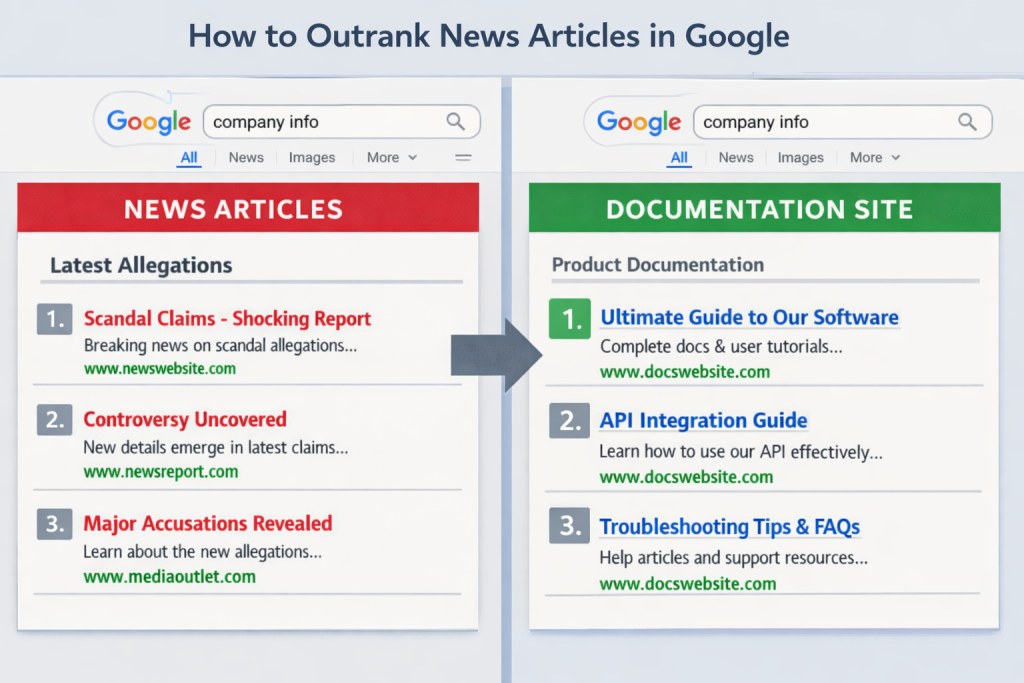
When people ask whether it is genuinely possible to outrank news articles in Google with a purpose-built website, they are usually asking with a mixture of hope and scepticism. The hope is obvious. The scepticism is reasonable: these are articles from The Washington Post, Business Insider, the BBC, and regional newspapers with decades of accumulated credibility. You are proposing to beat them in search rankings with a website that did not exist twelve months ago. That sounds improbable.
Table of Contents
- The Illusion of Invincibility: What Domain Authority Actually Means
- How Google Actually Decides What Ranks for Named Searches
- The Factor No One Talks About: Specific Query Volume vs. General Authority
- The Role of Primary Source Documents: Why Courts Beat Journalism
- Why This Works Permanently: The Compounding Advantage
- Why Execution Is the Whole Game
- A Real-World Benchmark
- What This Approach Cannot Do
- The Permanent Fix vs. the Ongoing Expense
- Frequently Asked Questions
It is not improbable. It happens regularly, and it happens for reasons that are entirely logical once you understand how Google actually evaluates content—not in the abstract, but in the specific context of a search about a named individual, a company, or a legal case. This article explains the mechanism: why high-authority news sites have the advantages everyone assumes they do, why those advantages are more fragile than they appear for certain searches, and why a well-built resource can compete with them—and hold that position.
This is not a quick fix and it is not guaranteed. It requires proper execution. But the underlying logic is sound, it is grounded in how search works, and it is borne out in practice.
The Illusion of Invincibility: What Domain Authority Actually Means
The concept most people have heard of is domain authority—the idea that Google trusts The Guardian more than a website registered last month. This is true, and it matters. But understanding precisely what it means, and what it does not, is the foundation of everything that follows.
Domain authority is shorthand for a cluster of trust signals Google has accumulated about a site over time: how many respected sites link to it, how long it has published, how consistently it produces content people engage with, how often it is cited. Collectively these tell Google: “when this domain publishes something, it is probably worth showing.”
That is a general trust signal. It tells Google that an outlet is a credible source of journalism. It does not tell Google that any specific article on that outlet is the best possible answer to any specific search.
Here is the critical distinction: Google does not rank websites. It ranks individual pages, in response to individual queries. A high-authority domain gives every page a head start—but the race is still run, and it is run on factors a dedicated, well-built resource can win.
How Google Actually Decides What Ranks for Named Searches
When someone searches “John Smith lawsuit outcome” or “Acme Corporation case dismissed”, the query is highly specific. Google is not looking for the best general journalism site; it is looking for the most relevant, comprehensive, and authoritative page addressing that exact query. That changes everything.
For these named searches, several factors shift in favour of a dedicated resource over a news article:
Topical Specificity and Relevance
A newspaper article about a lawsuit was written when the case was filed. Its headline and content are oriented around the allegations; the word “dismissed” may appear in a buried update, or not at all. A resource built around the outcome is oriented entirely around the resolution. For a search about how the case ended, it has overwhelming relevance the article does not.
Content Depth and Comprehensiveness
Google increasingly rewards what it calls “information gain”—content that adds something beyond what already exists. A 2021 article about a filing contains nothing about a 2023 dismissal. A dedicated resource can contain the full primary-source outcome, a detailed timeline, an explanation of what it means, and answers to the questions people actually ask. On completeness for that specific matter, there is no comparison.
Content Freshness for Evolving Stories
Search applies a “freshness” preference for topics where current information matters, and legal outcomes are exactly such a topic. A current account of a recently resolved case carries strong freshness signals relative to an article published years earlier about the original filing—an advantage that grows as the old coverage ages.
Architecture Aligned to the Outcome
News articles are written for immediate consumption, not for the searches people run years later. Their structure remains oriented around the original allegations even if a brief update was bolted on. A purpose-built resource is aligned, from the ground up, to the question “what actually happened in this case?” rather than “what was once alleged?” That alignment is a structural advantage that cannot simply be retrofitted onto an old article.
The Factor No One Talks About: Specific Query Volume vs. General Authority
Here is perhaps the most important and least-discussed point. The competition for a query like “John Smith lawsuit outcome” or “Acme Corporation v. Johnson dismissal” is nothing like the competition for “best Italian restaurant in London” or “how to invest in stocks”.
Searches about specific named individuals and specific cases have relatively low total volume. A major newspaper ranks first for vast numbers of high-volume general searches because it has built authority across an enormous breadth of topics. But for one precise query about how a particular case ended, that general authority counts for far less than people assume.
The reason is simple: the algorithm also evaluates the specific page competing for that query, not just the domain. If the only relevant page is an old article that never mentions the dismissal, it is losing on relevance, freshness, and completeness for the outcome query—regardless of the outlet’s general standing.
This is the seam in the armour. For broad, high-volume searches, general authority is close to insurmountable without years of investment. For specific named queries about legal outcomes, a focused, well-built resource can compete quickly.
The Role of Primary Source Documents: Why Courts Beat Journalism
There is a category of content that carries authority journalism cannot replicate: primary-source legal documents.
When a resource presents the actual outcome—the official record, with its date and reasoning—it offers something no news article contains. The article summarises what happened; the primary source is what happened, in the authoritative language, from the authoritative source. Presented with appropriate structured data, this also helps search engines recognise that they are dealing with legal documentation rather than opinion.
It matters to people, too. A prospective employer, investor, or partner who finds the actual record, with supporting material, receives evidence they cannot easily question. That authority translates into the engagement signals—time on page, low bounce, return visits—that reinforce rankings over time.
Why This Works Permanently: The Compounding Advantage
The word “permanently” deserves examination, because it is what distinguishes this approach from alternatives like PR retainers, paid search, or content flooding.
A PR retainer addresses reputation through ongoing activity: placing coverage, managing narratives. Stop paying and the activity stops; the underlying problem—that the favourable outcome does not rank—was never solved. Paid search places you at the top only while you pay; the moment the budget ends, you vanish, with no residual value. Content flooding requires constant production and can trigger quality filters when the material is thin or manufactured.
A dedicated resource works differently because it builds accumulated authority—a real asset that grows over time rather than an expense with no residual value. As it ages, earns references, and is engaged with, its position becomes more entrenched. The old articles are not getting fresher or more relevant to outcome queries; the resource is not getting less complete or less relevant. The competitive dynamic shifts in its favour every month, not against it.
Why Execution Is the Whole Game
Understanding why this works in principle is not the same as being able to deliver it, and this is where the honesty matters most. The principle is simple; the execution is exacting and unforgiving. The same idea, built carelessly, can fail to rank entirely—or, handled clumsily, draw fresh attention to the very allegations it was meant to contextualise.
This is why do-it-yourself attempts and generalist SEO agencies so often disappoint with these cases. It is a specialist discipline that combines an accurate grasp of the legal record, sensitivity to confidentiality, the craft of making documentation genuinely findable, and the patience to hold a position as search evolves. The concept is not the moat. The execution is.
A Real-World Benchmark
In one documented engagement, a professional had been the subject of serious allegations covered by national outlets. The case was later dismissed with prejudice, and a retraction was obtained from the complainant—yet none of the original coverage reflected the outcome. For anyone searching the person’s name, only the allegations appeared; the resolution was effectively invisible.
A purpose-built resource was created, presenting the outcome, a complete timeline, a point-by-point response to the original allegations, and clear answers to the obvious questions. Within a matter of weeks it reached the first page for the relevant searches. The original coverage no longer dominated the results, click-through ran well above the typical benchmark, and visitors spent real time reading—an indication they were absorbing the full picture. AI assistants, too, began returning the accurate outcome rather than repeating unresolved allegations.
This is a single example, but the mechanism behind it is not unique to one case. It is a function of how Google evaluates content for specific named queries, and it applies wherever the conditions are met: a favourable legal outcome, existing coverage of the allegations, and a resource built to a genuinely competitive standard.
What This Approach Cannot Do
Credibility requires honesty about limits.
It does not guarantee rankings. Search outcomes are probabilistic, and no honest practitioner promises a specific position. What can be said is that the structural factors above systematically favour a well-built, outcome-focused resource over ageing coverage for outcome queries, and that this tends to produce results when execution is sound.
It works best when the search is specific—a person’s full name combined with case-related terms. For broad queries about a company’s general reputation or an industry-wide controversy, the landscape is more challenging.
It does not delete existing coverage. The original articles remain indexed and accessible; they simply no longer dominate to the exclusion of the complete, accurate story. Balance, not suppression, is both the ethic and the practical outcome.
And it takes time—not the years required to build general domain authority, but weeks to months to establish strong positions, and ongoing care to hold them.
The Permanent Fix vs. the Ongoing Expense
The case for a dedicated resource as a permanent fix rests on a simple comparison.
PR retainers addressing reputation commonly run from around £4,000 to £12,000 per month, with no defined endpoint and no guaranteed ranking outcome. Over two years that is £96,000 to £288,000—and the underlying problem may still exist. A resource built to the right standard is a one-time investment with lasting residual value: once the positions are established, it continues working without ongoing spend, the authority compounds, and the old coverage keeps ageing.
The comparison is not between spending and not spending. It is between buying an asset and renting a service. The resource is the asset, and in search terms its value appreciates. For someone whose opportunities are constrained by outdated allegations—or a company whose due diligence is contaminated by a case that concluded in its favour years ago—it is the most direct, cost-effective, and durable solution available.
Frequently Asked Questions
How long does it realistically take to outrank news articles in Google?
It depends on the strength of the competing coverage and the quality of execution. In well-run cases, strong positions for specific named queries have been achieved within weeks; more competitive terms can take several months. General reputation queries are harder than case-specific ones.
Does this work for companies as well as individuals?
Yes. The mechanism is identical. Corporate defendants who achieved favourable outcomes face the same asymmetry—extensive coverage of allegations, invisible resolution—and the same solution applies, within appropriate confidentiality constraints.
Will this work if my settlement included confidentiality provisions?
Usually, with careful scoping. Most provisions restrict disclosure of terms and amounts, not the fact of a favourable outcome. Every case is different and legal review is advisable, but confidentiality rarely prevents effective documentation of a favourable result.
What happens if the original publication updates its article afterwards?
An update can affect that article’s ranking, but it rarely matches the completeness and outcome focus of a dedicated resource. And if an outlet does publish a substantial follow-up covering the outcome, that is positive—the favourable result then receives authoritative coverage too, and both contribute to a balanced set of results.
Is this approach ethical?
It is—arguably more so than the alternatives. The goal is not to suppress accurate information or manipulate search engines, but to ensure the complete, accurate story, including the favourable resolution, is as visible as the allegations. Presenting official records and factual timelines is the highest-integrity form of reputation work there is.
Does AI optimisation really matter for reputation management?
Increasingly, yes. More people use ChatGPT, Perplexity, and similar tools as first-line research, especially in due diligence. These systems draw on accessible web sources. If the only accessible material concerns the allegations, that is what they will report; if accurate, well-structured information about the outcome is available, they can incorporate it. Being visible to these systems is no longer optional for anyone serious about long-term reputation.
The complete story of a legal matter deserves to be as visible as the allegations.
If you have achieved a favourable outcome in litigation—a dismissal with prejudice, a settlement with no admission of wrongdoing, a retraction—and that outcome is not visible when people search for your case, FamoRenovo can change that.
Visit FamoRenovo to discuss your situation. Your legal victory deserves to be found.