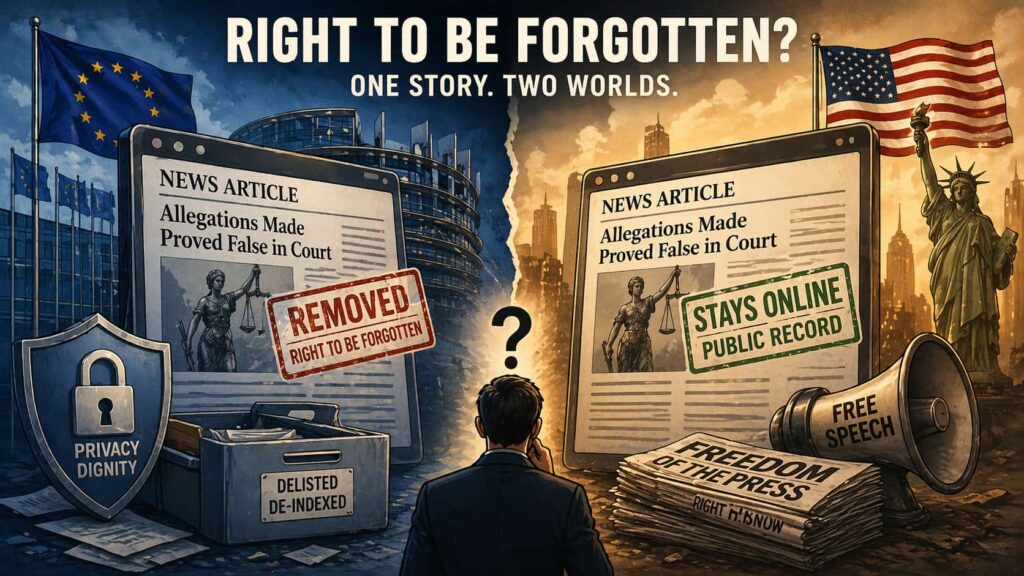
When a court dismisses a case, the legal record reflects that dismissal almost immediately. The public record of it, the one that lives in search results and feeds AI answers and shapes what prospective patients, clients, employers, and investors see when they type a name into Google, does not. The Right to be Forgotten exists in European law precisely to address that gap between legal outcome and informational reality. In the United States, no such right exists, and the structural asymmetry between those two worlds shapes every aspect of how professionals named in resolved legal matters can reclaim their reputations. Understanding the asymmetry, and knowing what tools actually work on each side of the Atlantic, is what this article sets out to do.
Table of Contents
The Right to be Forgotten: Europe’s Codified Framework
In May 2014, the Court of Justice of the European Union handed down its decision in Google Spain v AEPD and Mario Costeja Gonzalez. The ruling established that search engines are not passive intermediaries but data controllers with an active obligation to consider requests to de-index results that have become, in the court’s language, “inadequate, irrelevant or no longer relevant, or excessive in the light of the time that had elapsed.” The General Data Protection Regulation, which came into force four years later, codified this principle in Article 17 as the right to erasure, which together with the underlying case law is what most people mean when they refer to the Right to be Forgotten.
Subsequent case law has sharpened the doctrine considerably. In Google v CNIL (2019), the court confirmed that de-indexing obligations apply across the European Union but not globally, meaning a French executive cleared of wrongdoing can have results suppressed across Europe but not on Google.com for a US audience. In GC and Others v CNIL the same year, the court extended the Right to be Forgotten to sensitive personal data, including information about criminal investigations, subject to a public-interest balancing test. Most recently, in TU, RE v Google LLC (2022), the court shifted the evidential burden: Where a requester can show that the underlying information is manifestly inaccurate, Google must delist the results, and the obligation now extends to image thumbnails as well as text.
Taken together, these decisions give European citizens a practical legal mechanism. A physician whose malpractice suit was dismissed can apply for de-indexing. An executive whose shareholder action was withdrawn can request that the filing be delisted. The Right to be Forgotten is not automatic and involves a balancing exercise against press freedom and public interest, but it exists as a formal pathway. The law treats the persistence of outdated or one-sided information about a private individual as a harm that regulators and courts can act on.
Why the US Has No Right to be Forgotten
The United States has taken the opposite trajectory. The First Amendment’s protection of truthful publication about matters of public record makes the European approach legally unviable in the US. As comparative legal scholarship has repeatedly noted, few US courts have recognised any version of the Right to be Forgotten, and it is unlikely ever to be accepted at a constitutional level.
Worse, the limited tools that do exist in the US, such as expungement of criminal records, have been weakened by case law that prioritises informational access over informational accuracy. In G.D. v Kenny, the New Jersey Supreme Court held that defendants in defamation actions can assert truth as a defence even when the relevant facts are subject to an expungement order, on the reasoning that the information was in the public domain before the expungement took effect. This means that even a legally erased record can still be republished, cited, and searched without the original subject having any meaningful remedy.
The structural consequence is stark. A physician in Manchester whose malpractice suit was dismissed has a clear legal pathway through the Right to be Forgotten to request that search engines de-index the coverage. A physician in Boston in the identical situation has no such pathway. The filing sits on aggregator sites like PlainSite, Trellis, and UniCourt. The local press coverage of the lawsuit remains indexed. The dismissal, if covered at all, ranks below. And autocomplete suggestions quietly couple the physician’s name to the word “lawsuit” in every future search, reinforcing the association with each click.
The Commercial Consequences of the Asymmetry
This is not merely an academic curiosity. The gap between jurisdictions has real and measurable effects on professional careers, insurance decisions, patient choices, and business relationships. A US physician loses hospital privileges or patient volume because search results frame an old allegation as current fact. An executive is quietly passed over for a board seat because a dismissed derivative action still dominates their name query. A professional services firm loses a mandate because a partner’s name triggers coverage of a matter that was resolved in their favour five years earlier.
The issue is particularly acute in regulated professions, where D&O insurers and medical malpractice carriers perform reputational due diligence that relies heavily on what is publicly available. An underwriter reviewing a physician’s application does not have time to read through a docket and establish that a case was dismissed on summary judgment. They see the filing, they see the coverage, they factor it into their risk assessment. The dismissal might be a matter of formal record, but the informational record is what actually drives the commercial outcome.
The European Right to be Forgotten framework does not solve this problem entirely. It operates only within EU territory. It requires active application by the affected individual, often with legal assistance. And it has been interpreted narrowly where public interest considerations apply. But it does provide a formal mechanism that simply does not exist in the US. For US-based professionals, the only available levers are non-legal: Content production, search engine optimisation, strategic communications, and the structural reshaping of what appears when a name is searched.
This is the gap that FamoRenovo was built to fill.
How FamoRenovo Addresses the Problem in Both Jurisdictions
FamoRenovo’s core product is the Record of Truth: A comprehensive, legally accurate, evidence-based account of the resolution of a legal matter, published on an independent hosting domain purpose-built to rank for the name-plus-legal-query combinations that are currently returning damaging results. The methodology recognises a fundamental point that distinguishes it from conventional online reputation management services. The problem is not that damaging content exists. The problem is that resolving content does not exist with equivalent authority, structure, and findability.
The Record of Truth is not editorial commentary. It is not a blog post asserting innocence. It is a structured, primary-source record of what actually happened, built around court documents, retraction letters, settlement agreements, and official dispositions, and published in a form that search engines and AI training pipelines can read, verify, and weight accordingly. Schema.org structured data is implemented throughout, including ClaimReview markup for disputed allegations, LegalAction markup for case documentation, FAQPage markup for common questions, and Person markup linking the subject’s professional identity to the corrective record.
The independent hosting domain is central to the approach. Publishing the Record on FamoRenovo’s own site would tie its authority to FamoRenovo’s brand and would inherit the SEO profile of a commercial service. Publishing it on an independent domain built for the specific topic area allows the Record to acquire authority in its own right, ranked for the exact queries that are causing damage, without the structural signals that search engines associate with promotional content.
For clients in the European Union, FamoRenovo’s work complements the legal pathway. A successful Right to be Forgotten application removes results from European search engines, but the underlying content remains on the originating websites and continues to appear in global queries, non-EU searches, and AI-generated answers. The Record of Truth ensures that when the content is surfaced, whether by a search engine that has not de-indexed it or by an AI system answering a question about the subject, the resolving context is available, authoritative, and findable alongside the original allegation.
For clients in the United States, FamoRenovo is often the only practical remedy. With no Right to be Forgotten available, and with the First Amendment protecting the continued publication of truthful coverage of filings, the only effective response is to ensure that the truthful coverage of the resolution is equally findable. The Record of Truth achieves this by occupying the search space around the subject’s name with accurate, structured, evidence-based content that search algorithms and AI systems rank as authoritative. The goal is not to suppress the original coverage. It is to ensure that the original coverage is no longer all that a searcher finds.
The AI optimisation layer is increasingly important as search behaviour shifts. When a prospective patient asks ChatGPT or Claude about a physician, the answer draws on training data and retrieval sources that weight content by structural authority and primary-source evidence. A Record of Truth built to these standards becomes part of the answer. A buried court order does not.
Closing the Gap
The European and American approaches to online reputational harm will not converge. The constitutional, cultural, and regulatory differences are too deeply rooted. The Right to be Forgotten will remain a European right, and the First Amendment will remain an American protection, and professionals affected by resolved legal matters will continue to face different tools in different jurisdictions. What has emerged instead is a practical, jurisdiction-independent methodology that addresses the underlying problem through the informational system itself, rather than through a legal pathway that exists in one place and not the other. FamoRenovo’s Record of Truth is that methodology, and its growing relevance in both markets reflects a simple truth: When vindication has already happened, what clients need is not a verdict, but a record that the world can actually find.
Frequently Asked Questions
Does the Right to be Forgotten apply in the United States?
No. The Right to be Forgotten is a European legal doctrine established by the Court of Justice of the European Union in 2014 and codified in Article 17 of the GDPR in 2018. The United States has no equivalent right, and the First Amendment’s protection of truthful publication about matters of public record makes the European model legally unworkable in the US. US professionals affected by outdated or one-sided search results have no formal legal mechanism to request de-indexing and must rely on non-legal remedies such as structured corrective content and SEO-based reputation restoration.
How does the Right to be Forgotten actually work in the EU?
The Right to be Forgotten allows individuals to request that search engines de-index results that are inadequate, irrelevant, no longer relevant, or excessive in light of the time that has elapsed. The affected person submits a request to the search engine, which conducts a balancing exercise between the individual’s privacy interests and the public interest in continued access to the information. If the search engine refuses, the individual can escalate to a national data protection authority or court. Approved requests result in the URL being suppressed from name-based searches across the European Union, though the underlying content remains on the originating website and visible outside the EU.
What happens to search results when a lawsuit is dismissed?
In most cases, almost nothing. The original filing and its coverage remain indexed on aggregator sites, press websites, and in search engine results. Dismissals are rarely reported with the same prominence as filings, so the resolving information almost never achieves the same search ranking. Autocomplete suggestions that couple the defendant’s name with “lawsuit” persist, and the association is reinforced each time someone clicks through. Without active intervention, a dismissed case continues to look like an active allegation in search results for years or even decades after the legal matter has closed.
Can FamoRenovo help if the Right to be Forgotten is not available?
Yes. FamoRenovo’s Record of Truth methodology was designed specifically for jurisdictions where no legal de-indexing pathway exists, and it also complements the Right to be Forgotten in jurisdictions where it does. The approach publishes structured, evidence-based documentation of a case’s resolution on an independent hosting domain, built to rank for the specific search queries that are currently returning damaging results. The methodology works regardless of jurisdiction because it addresses the informational system directly rather than relying on legal intervention. For US clients, it is often the only available remedy. For EU clients, it fills the gaps that the Right to be Forgotten leaves unaddressed, including global search results, AI-generated answers, and content on originating websites that remains beyond the scope of de-indexing orders.
Search Visibility Checker
Enter names or organizations who have had lawsuits, investigations, or allegations. The eligibility check will analyze what Google shows and explain whether FamoRenovo can help.
Client names run the Google search and are then discarded - we don't log them, store them, or use them to contact you. We never share client data. Privacy details
Names live only in your browser, are sent to our search provider for the search alone, then discarded. They are never stored on our systems, never sold, and never used to contact you.
Create a free account and we will give you a signed Confidentiality Undertaking from FamoRenovo to download and keep, before you commission anything. If your firm requires its own NDA, we will countersign yours.